10:00A Sunday morning
The coffee is still warm. Sunlight is reaching the living room, and you're standing in front of a bookshelf you've walked past a thousand times.
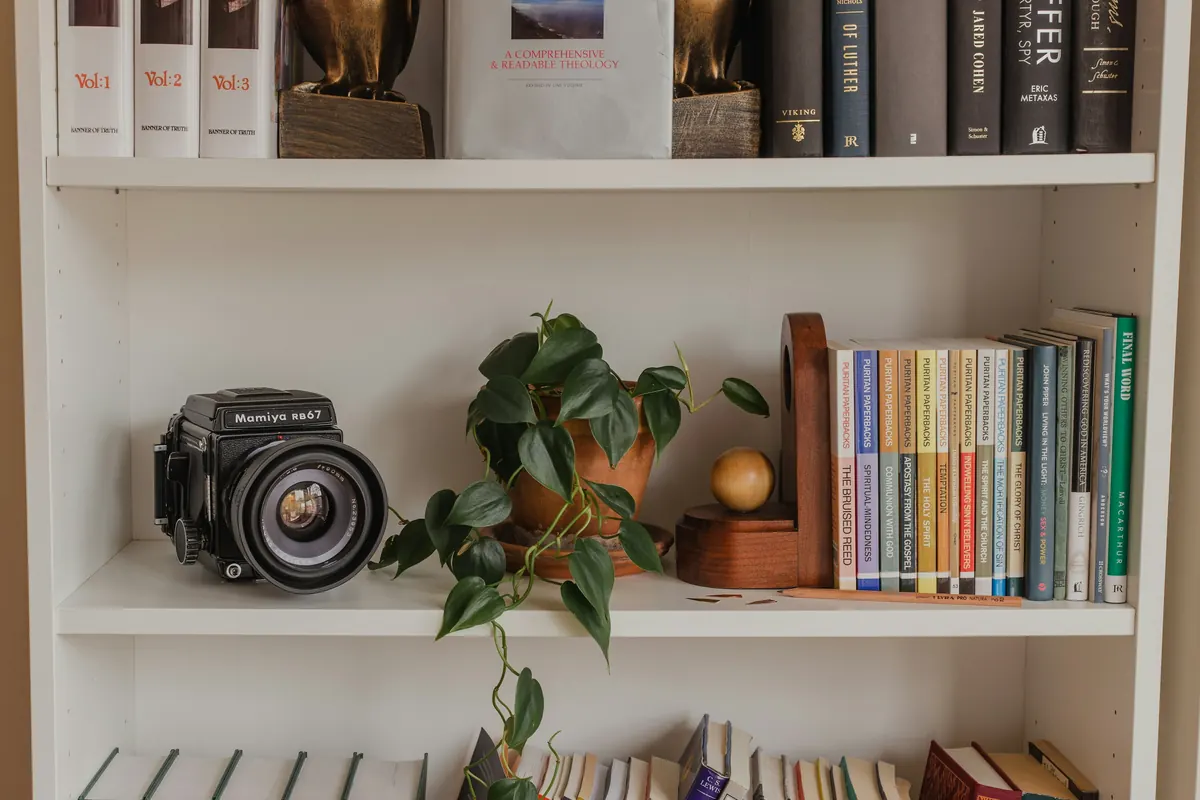
There are books you love, books you haven't opened in years, a little plant growing in its own direction, and a few objects that somehow ended up there after the last time you cleaned.
Nothing is particularly wrong. But the shelf feels a little tired.
You consider buying matching storage boxes. Perhaps a new vase. Then you notice an old camera tucked between the books, and a photograph you haven't looked at properly in months.
Perhaps the shelf doesn't need anything new. Perhaps it simply needs you to look again.
The bookshelf you already have
A bookshelf is one of the most personal pieces of furniture in a home. It can hold the novels you return to, books inherited from someone you love, travel memories, photographs, ceramics and the ordinary things that accumulate over time.
Yet when we look for bookshelf inspiration, we often find shelves arranged as though every object had been chosen to coordinate with the others. Beautiful, perhaps. But is that how we want to live?
At ORIGIN. House Studio, we prefer a bookshelf that feels collected rather than constructed. One where the books can still be read, the objects mean something, and nobody has to dismantle an arrangement to find a favorite story.
The goal isn't perfection. It's rhythm, balance and personality. And you can begin with a single shelf.
Books are the main characters
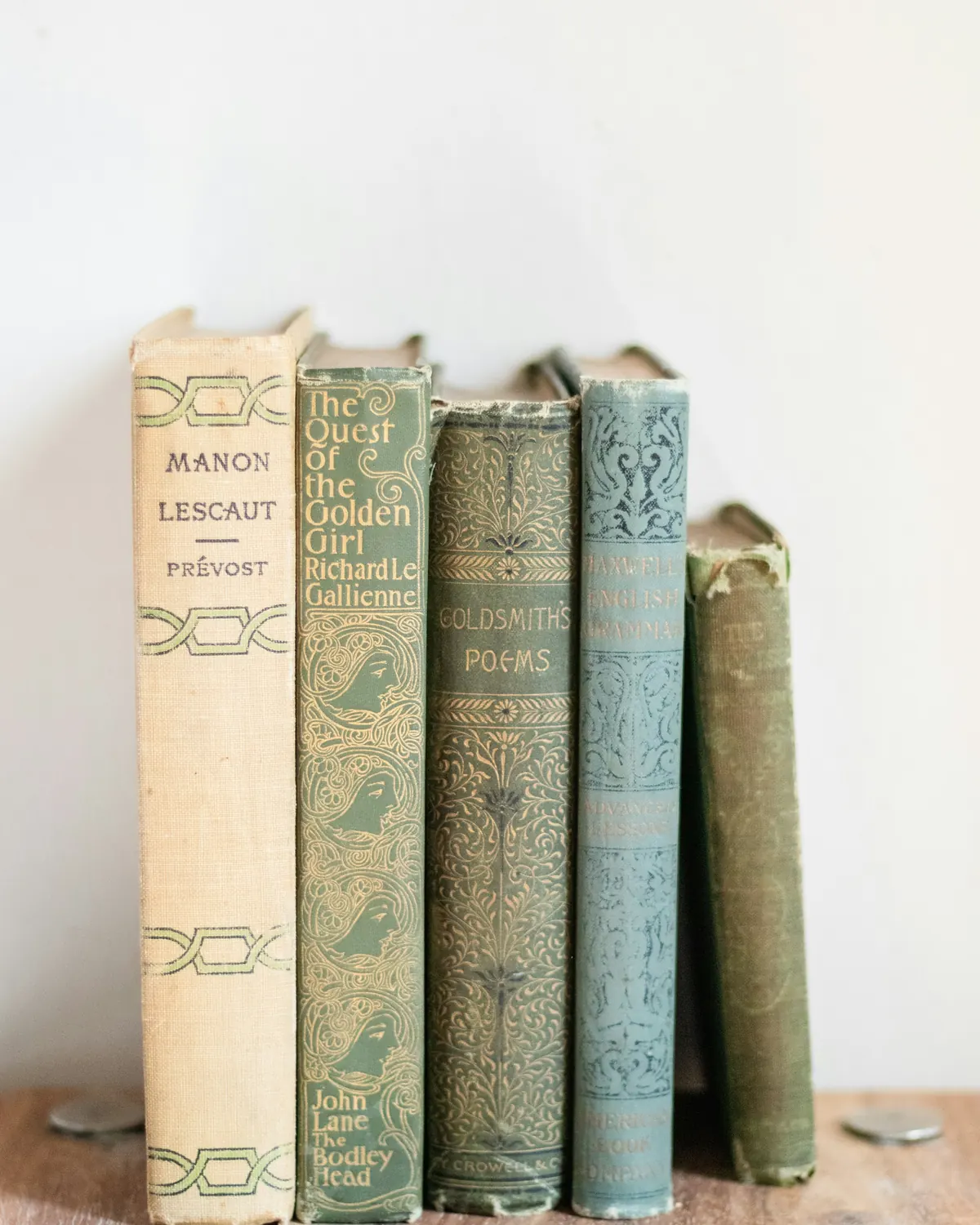
Before thinking about decorative objects, look at the books themselves. Their spines create color, texture, height and variation. Some are tall and narrow. Others are small, worn or wonderfully irregular.
They don't have to be organized by color to become visually interesting. Five books standing together can create a calm vertical group. A small horizontal stack introduces a different shape. And a book placed where you can easily reach it becomes an invitation to read, not just another decorative element.
Think of your books as a collection of forms rather than a problem to hide. Their differences are part of their charm.
Your bookshelf, reimagined in eight steps
- 1Start with one shelf
You don't need to empty an entire bookcase. Choose a single level or a small section that feels crowded. Remove the objects carefully, leaving heavier books where it's safest to keep them.
- 2Decide what belongs there
Gather the books you enjoy seeing or reaching for. Add one or two personal objects. Don't worry about matching colors. Ask yourself what you want this part of the shelf to say about your life.
- 3Create a vertical group
Stand several books upright, supported so they don't fall or bend. A group of different heights can feel natural. Keep the titles facing out, so they stay easy to find.
- 4Introduce a horizontal stack
Lay a few books flat beside the vertical group. Keep the stack stable and low enough to use comfortably. The contrast between upright and horizontal gives the shelf a new rhythm.
- 5Add something with a story
Bring back one object that means something to you: a photograph, an old camera, a ceramic piece or a small souvenir. It doesn't have to be valuable. Its place in your life is enough.
- 6Leave a little breathing room
Resist filling every gap. A small clear area lets the eye notice books and objects one by one. The empty space doesn't have to be perfectly symmetrical.
- 7Consider a plant or a natural detail
If you already have a plant, place it where the light suits it and the shelf can safely hold the pot. Keep water away from books. A branch in a stable vase can also bring an irregular shape.
- 8Look at the light, then live with it
Step back and observe the shelf during the day. Check that everything is stable, nothing blocks a walkway and your favorite books are easy to reach. Use the shelf normally before changing anything else.
The rhythm between things
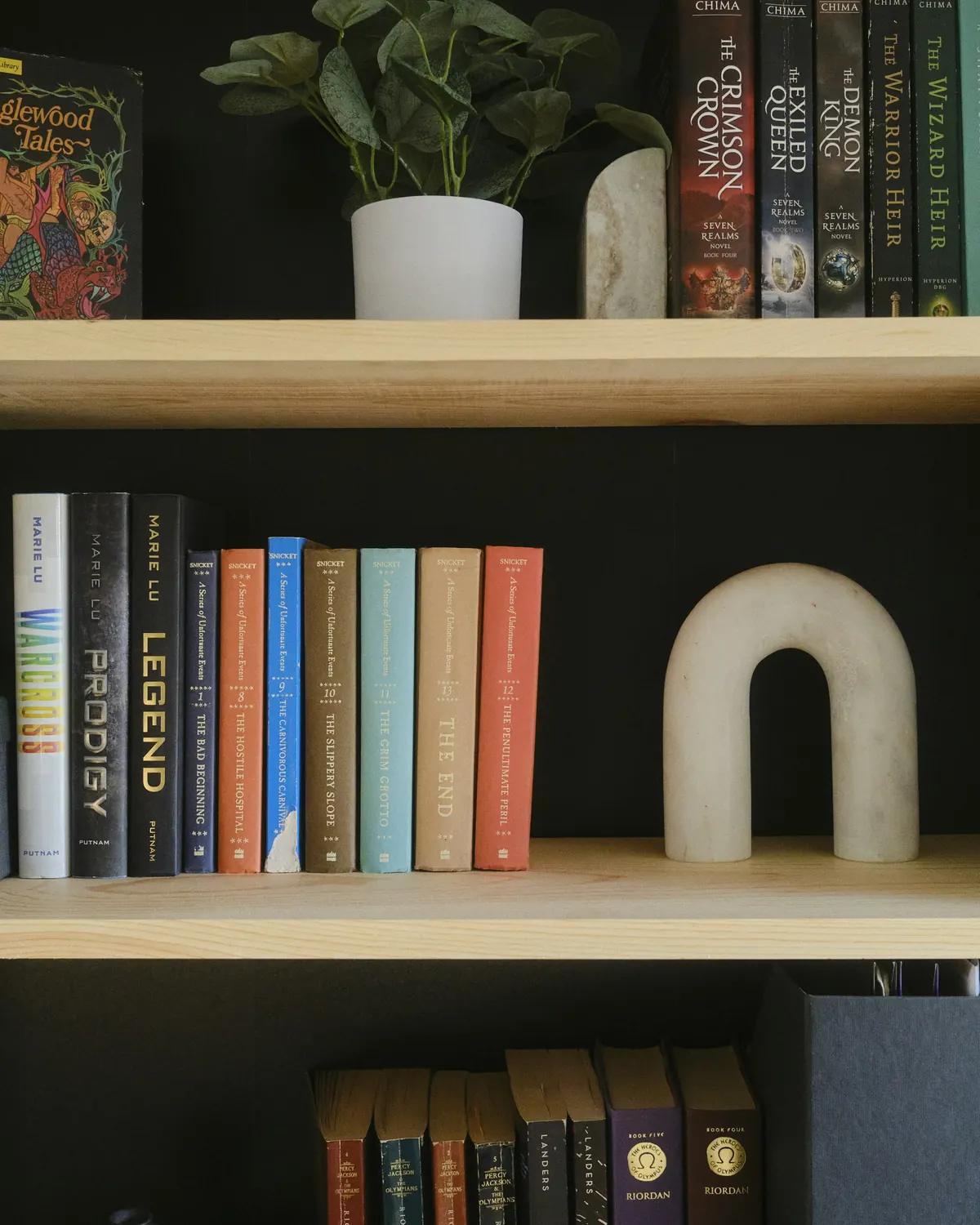
Look at a dark shelf with colorful books, a white planter and an object shaped like an arch. The books create vertical lines and irregular blocks of color. The planter introduces another volume. The arch offers a curve among the straight edges.
But there's a quieter element in the composition: the space between the objects. Without it, everything begins to compete. With a little separation, each piece has room to be noticed.
This is one of the simplest ideas to borrow: think about relationships, not isolated objects. Something tall beside something low. Something straight near something curved. A familiar photograph alongside a stack of books.
You don't need a formula. You need a rhythm that feels comfortable to you.
Five mistakes that make it harder
- 01Arranging everything by color A color-sorted shelf can be beautiful, but it isn't necessary. If finding a book becomes difficult, choose a system that suits the way you read.
- 02Filling every available space A shelf doesn't need to display everything you own. Giving objects a little room makes the arrangement easier to enjoy and to keep.
- 03Using too many decorative objects Bookshelves are still places for books. Start with what you read and love, then add a few pieces that truly belong there.
- 04Building unstable stacks Avoid leaning heavy objects against fragile ones or making tall piles that can fall. Keep the furniture stable, and secure it to the wall when needed.
- 05Copying a photograph too literally A beautiful reference can inspire you, but its objects belong to another home. Your own books, memories and routines should decide the result.
When a shelf is full of books
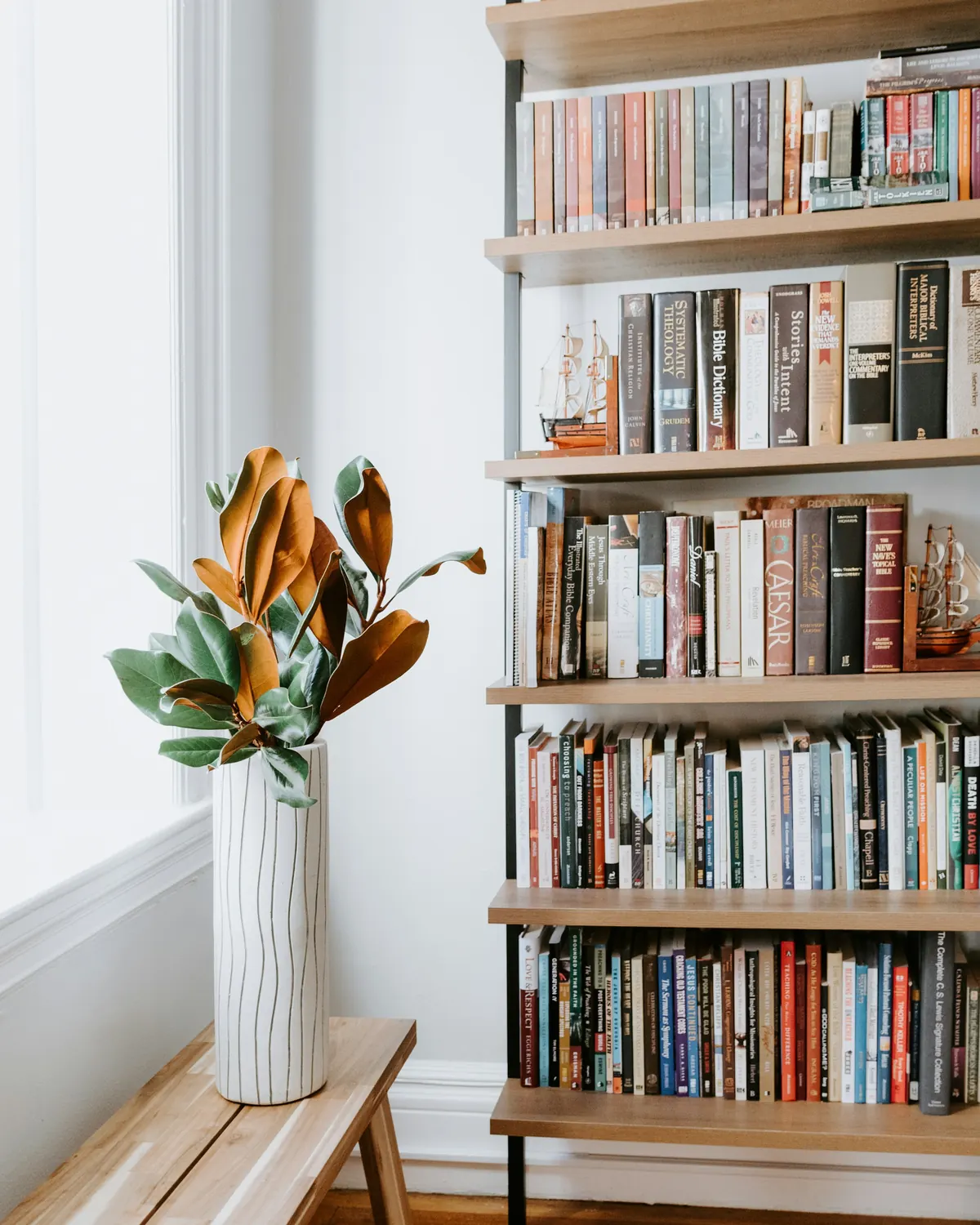
Not every bookshelf needs decorative gaps. Some of the most inviting ones are full from top to bottom: books standing close together, a vase near the window, and the sense of a life spent reading and collecting.
If you truly need all that storage, don't feel obliged to remove books just to create a minimalist composition. Make a few small adjustments instead. Keep the books you use most within easy reach. Place heavier volumes on lower, well-supported shelves. Let the window keep working, and avoid placing objects where they could be knocked over.
If you have room for just one personal thing, use it well. A single vase, a framed photograph or a meaningful object may be enough. A full bookshelf can have character, too. What matters is that it works for the life around it.
The shelf that tells your story
There's a particular pleasure in noticing unexpected connections between familiar objects. A novel you bought years ago sits beside a book someone gave you. A photograph reminds you of a trip. A ceramic bowl comes from a different chapter of your life.
None of those stories needs to be explained to every visitor. You know why the objects matter. And that gives the shelf something no perfectly coordinated display can supply: identity.
A beautiful bookshelf doesn't need better objects. It needs to give the objects you love a better place to live.
If the answers feel right, stop editing.
A little later in the day
It's almost noon. The coffee cup is empty. A few books have changed places, the plant has found a better position, and the old camera is now somewhere you can actually see it.
You haven't bought anything. You haven't turned the living room into a showroom. But the bookshelf feels different. More deliberate, perhaps. More personal, certainly. And you can still take a book from the shelf without disturbing the whole arrangement.
If you're looking for more ways to give familiar belongings a better place, read our guide to small spaces with big character.
Because styling a bookshelf isn't really about creating the perfect display. It's about making room for the stories that already belong to you.
Sources & notes
- Original editorial guide by ORIGIN. House Studio. No statistics, market data or product claims are used.
- The eight steps are a practical method, not a universal design rule. Adapt them to your furniture, its stability and what your plants need.
- Photos (Unsplash License): Fiona Murray-deGraaff, Avery Evans, Kelly Sikkema, Brandon Cormier.
10:00Una mañana de domingo
El café todavía está caliente. La luz entra en la sala y tú estás frente a una estantería por la que has pasado cientos de veces.
Hay libros que te encantan, otros que no has abierto en años, una planta que crece a su manera y algunos objetos que terminaron allí después de la última vez que ordenaste.
Nada está especialmente mal. Pero la estantería se siente un poco olvidada.
Piensas en comprar cajas de organización que combinen. Quizá un florero nuevo. Entonces descubres una cámara antigua entre los libros, y una fotografía a la que no habías prestado atención desde hace meses.
Quizá no necesitas nada nuevo. Tal vez solo necesitas mirar otra vez.
La estantería que ya tienes
Una biblioteca es uno de los muebles más personales de una casa. Puede guardar las novelas a las que siempre regresas, libros que heredaste, recuerdos de viajes, fotografías, cerámicas y pequeñas cosas que se fueron acumulando con los años.
Sin embargo, cuando buscamos inspiración, muchas veces encontramos composiciones en las que cada objeto parece elegido para combinar perfectamente con los demás. Pueden ser bonitas, claro. Pero ¿es así como queremos vivir?
En ORIGIN. House Studio nos gustan las bibliotecas que parecen haberse formado con el tiempo. Aquellas donde todavía puedes sacar un libro para leer, los objetos tienen significado y nadie necesita desarmar una composición para encontrar su novela favorita.
El objetivo no es la perfección. Es encontrar ritmo, equilibrio y personalidad. Y puedes empezar con una sola repisa.
Los libros son los protagonistas
Antes de pensar en objetos decorativos, observa los libros. Sus lomos aportan colores, texturas, alturas y pequeñas diferencias. Algunos son altos y estrechos. Otros son pequeños, antiguos o tienen marcas de uso.
No necesitas ordenarlos por color para que resulten interesantes. Cinco libros en vertical pueden formar un grupo tranquilo. Una pequeña pila horizontal introduce otra forma. Y un libro colocado donde puedes alcanzarlo con facilidad se convierte en una invitación a leer, no solo en un elemento decorativo.
Mira tus libros como una colección de formas, no como un problema que debes ocultar. Sus diferencias también forman parte de su encanto.
Tu estantería, reinventada en ocho pasos
- 1Empieza por una sola repisa
No necesitas vaciar toda la biblioteca. Elige un nivel o una sección que se sienta demasiado llena. Retira los objetos con cuidado y deja los libros más pesados donde sea más seguro mantenerlos.
- 2Decide qué merece quedarse
Reúne los libros que disfrutas mirar o consultar. Añade uno o dos objetos personales. No te preocupes por combinar colores. Pregúntate qué te gustaría que ese rincón contara sobre tu vida.
- 3Crea un grupo vertical
Coloca varios libros de pie, bien apoyados para que no se caigan ni se doblen. Las distintas alturas crean una composición natural. Deja los títulos a la vista, para que sigan siendo fáciles de encontrar.
- 4Introduce una pila horizontal
Coloca unos cuantos libros acostados junto al grupo vertical. Mantén la pila estable y a una altura cómoda. El contraste entre ambas posiciones le da otro ritmo a la estantería.
- 5Añade algo con historia
Recupera un objeto que tenga significado para ti: una fotografía, una cámara antigua, una pieza de cerámica o un recuerdo de viaje. No necesita ser valioso. Su lugar en tu vida es suficiente.
- 6Deja un poco de espacio libre
Evita llenar cada hueco. Una pequeña zona despejada permite apreciar mejor los libros y los objetos. El espacio vacío tampoco tiene que ser perfectamente simétrico.
- 7Considera una planta o un detalle natural
Si ya tienes una planta, colócala donde reciba la luz que necesita y la repisa soporte la maceta con seguridad. Mantén el agua lejos de los libros. Una rama en un florero estable también aporta una forma irregular.
- 8Observa la luz y vive con ella
Aléjate un poco y mira la composición durante el día. Comprueba que todo esté estable, que nada obstruya el paso y que alcances tus libros favoritos. Usa la estantería normalmente antes de cambiar algo más.
El ritmo que existe entre los objetos
Observa un estante oscuro con libros de colores, una maceta blanca y un objeto escultórico en forma de arco. Los libros aportan líneas verticales y bloques irregulares de color. La maceta introduce otro volumen. El arco suma una curva entre tantos bordes rectos.
Pero hay otro elemento, menos evidente: el espacio que queda entre las piezas. Sin ese espacio, los objetos empiezan a competir por la atención. Con un poco de separación, cada uno tiene la oportunidad de destacar.
Es una de las ideas más sencillas que puedes aplicar: piensa en las relaciones entre los objetos, no en cada pieza por separado. Algo alto junto a algo bajo. Una forma recta cerca de una curva. Una fotografía conocida al lado de una pila de libros.
No necesitas una fórmula. Necesitas un ritmo que te resulte agradable.
Cinco errores que lo complican
- 01Ordenarlo todo por color Una estantería ordenada por colores puede ser bonita, pero no es indispensable. Si después te cuesta encontrar un libro, elige un sistema que se adapte mejor a tu manera de leer.
- 02Llenar todos los espacios No necesitas exhibir todo lo que tienes. Dar un poco de aire a los objetos permite disfrutar mejor la composición y mantenerla con facilidad.
- 03Sumar demasiados objetos decorativos Una biblioteca sigue siendo un lugar para libros. Empieza con lo que lees y aprecias, y después incorpora algunos objetos que de verdad tengan sentido allí.
- 04Hacer pilas inestables Evita apoyar objetos pesados contra piezas frágiles o hacer torres que puedan caer. Mantén el mueble estable y fíjalo a la pared cuando haga falta.
- 05Copiar una fotografía al pie de la letra Una imagen bonita puede inspirarte, pero sus objetos pertenecen a otra casa. Tus libros, tus recuerdos y tus rutinas deben definir el resultado.
Cuando una biblioteca está llena de libros
No todas las estanterías necesitan huecos decorativos. Algunas de las más acogedoras están llenas de arriba abajo: libros muy juntos, un florero cerca de la ventana y la sensación de una vida dedicada a leer y coleccionar.
Si de verdad necesitas todo ese espacio, no tienes por qué retirar libros solo para conseguir una composición minimalista. Haz pequeños ajustes. Mantén a mano los libros que más usas. Coloca los volúmenes pesados en las repisas inferiores, bien apoyadas. Deja que la ventana siga funcionando y evita poner objetos donde puedan caerse.
Si solo tienes lugar para un detalle personal, aprovéchalo. Un florero, una fotografía enmarcada o una pieza significativa pueden ser suficientes. Una biblioteca llena también puede tener mucha personalidad. Lo importante es que acompañe la vida que sucede a su alrededor.
La estantería que cuenta tu historia
Hay algo especial en descubrir conexiones inesperadas entre objetos conocidos. Una novela que compraste hace años aparece junto a un libro que alguien te regaló. Una fotografía te recuerda un viaje. Un cuenco de cerámica pertenece a otra etapa de tu vida.
No tienes que explicar cada una de esas historias a quienes visitan tu casa. Tú sabes por qué importan. Y eso le da a la estantería algo que ninguna composición perfectamente coordinada puede reemplazar: identidad.
Una biblioteca bonita no necesita objetos mejores. Necesita darles un mejor lugar a los objetos que ya quieres.
Si las respuestas te convencen, deja de hacer cambios.
Un poco más tarde
Ya casi es mediodía. La taza de café está vacía. Algunos libros cambiaron de lugar, la planta encontró una posición mejor y la cámara antigua ahora está donde de verdad puedes verla.
No compraste nada. Tampoco convertiste la sala en una sala de exposición. Pero la estantería se siente diferente. Quizá más equilibrada. Sin duda, más personal. Y todavía puedes sacar un libro sin desarmar toda la composición.
Si buscas más maneras de darles un mejor lugar a tus cosas, lee nuestra guía sobre espacios pequeños con mucha personalidad.
Porque decorar una estantería no consiste en crear la exhibición perfecta. Consiste en hacerles espacio a las historias que ya forman parte de tu vida.
Fuentes y notas
- Guía editorial original de ORIGIN. House Studio. No se usan estadísticas, datos de mercado ni afirmaciones sobre productos.
- Los ocho pasos son un método práctico, no una regla universal de diseño. Adáptalos a tus muebles, a su estabilidad y a lo que necesitan tus plantas.
- Fotos (licencia de Unsplash): Fiona Murray-deGraaff, Avery Evans, Kelly Sikkema, Brandon Cormier.