11:18A picture in your hands
You're standing in the living room with a framed picture in your hands. The sofa is exactly where it belongs, the cushions are slightly untidy, and there's an empty space on the wall that has been waiting for attention.
You hold the picture against the wall. A little higher. Then lower. Then higher again. Someone in the doorway suggests moving it to the left. You step back, tilt your head and realize you've lost all sense of where it should go.
There must be an easier way. Fortunately, there is a useful starting point, and it involves one measurement rather than an afternoon of guessing.
The little rule that changes how we see art
In Apartment Therapy, Maxwell Ryan recommends hanging artwork with its center about 57 inches (145 cm) above the floor. The important word is center. You don't measure from the floor to the top of the frame or to its bottom edge; you measure to the midpoint of the artwork itself.
Ryan describes this height as average eye level and a standard used in many galleries and museums. It's a familiar reference for displaying art, not an official rule every home must obey. What makes it interesting is the relationship it creates between a picture, the furniture and the people looking at it.
A frame hung very high can feel disconnected from the sofa or sideboard below it. Bringing it closer to eye level helps it become part of the room rather than something floating above it.
It's a starting point, not a substitute for looking. Before reaching for the hammer, consider the size of your picture, the furniture below it and the wall around it. Then do the math.
The calculation looks more complicated on paper than it is. You're simply finding the difference between the center of the picture and the point it actually hangs from. Once you know that difference, you know where the hook belongs.
A real example, without guessing
Let's start with the example Apartment Therapy gives. Your framed picture is 20 inches tall, so half its height is 10 inches, and the taut wire sits 2 inches below the top edge. Ten minus two is eight: the hook goes 8 inches above the 57-inch mark, at 65 inches from the floor, and the center of the picture ends up at 57 inches.
Now the same logic with our own rounded metric example. Imagine a picture 50 cm tall, with its wire 5 cm below the top edge. Half the picture is 25 cm; subtract 5 and you get 20 cm. Add that to the 145 cm reference and the hook goes at about 165 cm from the floor.
The numbers differ because this is a separate example, not an exact conversion of the first one. The method is identical.
What if you have more than one picture?

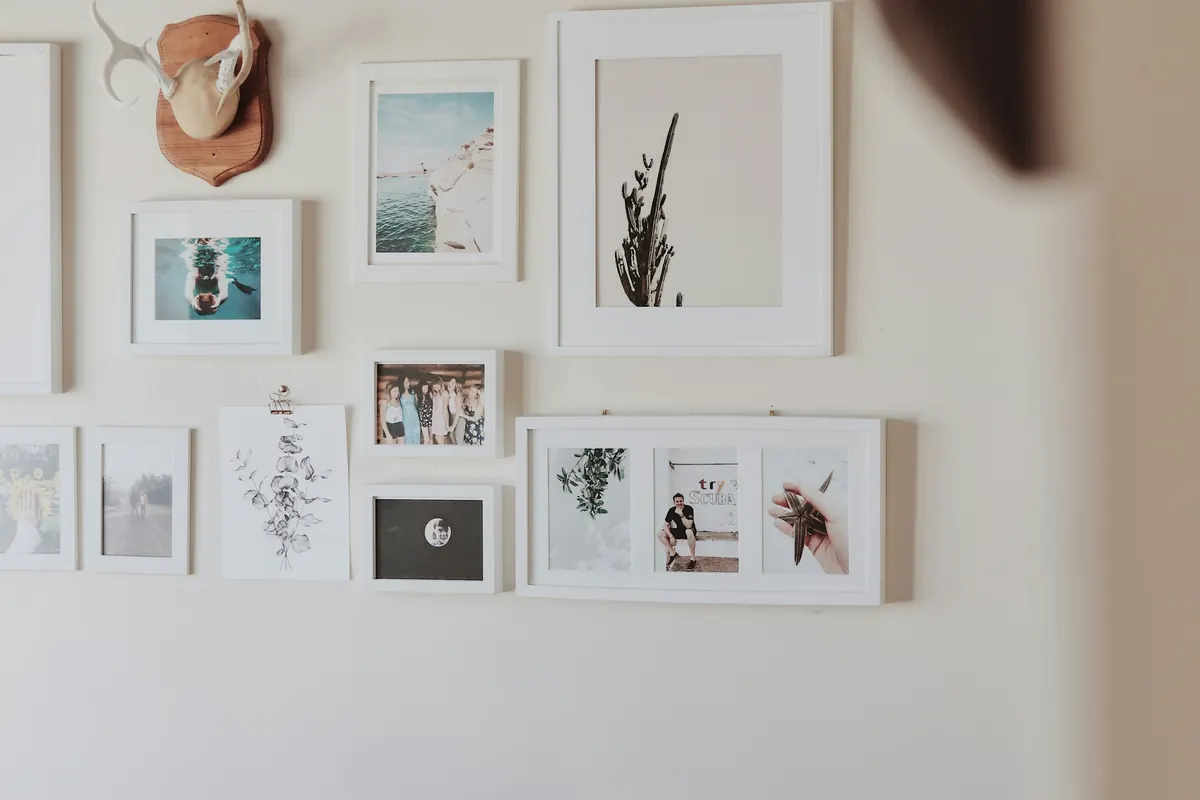
Picture yourself in a gallery, looking at several framed photographs hung together. They sit in a clear relationship with your eyes: you don't have to look for them near the ceiling or lower your gaze toward the floor. That same sense of connection can guide a gallery wall at home.
Apartment Therapy suggests treating a group of pictures as one large piece. Instead of centering every frame at 57 inches (145 cm), think about the whole composition. Lay the frames out on the floor first and move them around until the arrangement feels balanced, letting different sizes, orientations and subjects live together. Paper templates help you transfer the plan to the wall.
Then choose a visual center for the whole group, or one main piece to guide the others, and place it using the 57-inch reference. There's no need for identical frames or perfectly symmetrical spacing. The arrangement should make sense as a collection.
When the rule isn't the most interesting answer
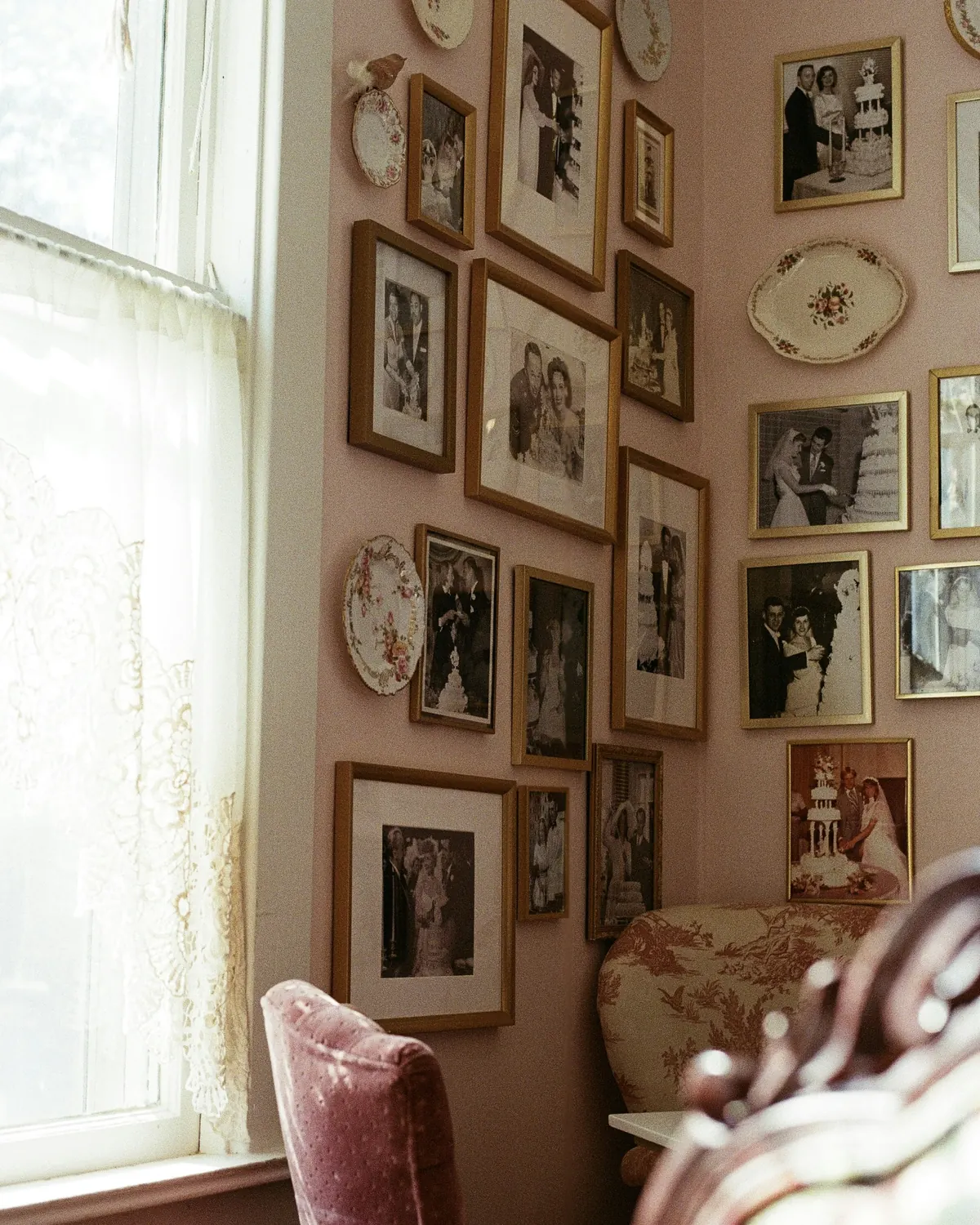
Now imagine a different room. Old family photographs and decorative plates cover much of a wall, from near the floor almost to the ceiling. A pink armchair sits beneath them and daylight comes in through a window with a sheer curtain. It's an expressive, deeply personal composition, and forcing every piece onto one horizontal line would change its character entirely.
This is where a guideline matters less than the intention behind the arrangement. A collected wall can work through rhythm, repetition, contrast and the stories its objects share. You might use one central frame as a reference and let smaller pieces spread around it, or deliberately cover more of the wall. What matters is that it's a conscious choice, not a random one.
The right height isn't only about measurement. It's about helping art belong to the room around it.
Five common mistakes when hanging art
- 01Measuring to the top of the frame The 57-inch guideline refers to the center of the piece. Measuring to the top edge can put the whole picture much lower than you meant.
- 02Forgetting the hanging wire The hook rarely sits at the top edge of the frame. Measure the wire under tension before working out where the fixing goes.
- 03Hanging everything too high Pictures feel disconnected from the furniture when there's too much empty wall between them. Step back and look at the whole composition.
- 04Treating a gallery wall as separate pieces A collection feels more intentional when it's planned as one arrangement, with a visual center and a relationship among the frames.
- 05Using one measurement everywhere A picture above a tall fireplace or an unusual architectural feature may need a different height. Adapt the guideline to the real room.
What about the sofa underneath?
One of the most common questions is how much space to leave between the sofa and the art. The 57-inch reference doesn't set a universal gap, and it doesn't need to. Look at the sofa and the picture together. Does the art feel connected to the seating, or does it float separately above it? Is there enough breathing room between frame and furniture? Would it look more balanced if it moved slightly?
Use the center height as a first reference, then step back and look at the whole wall. The same goes for the spacing between several frames: aim for a sense of continuity without forcing every arrangement into one formula. And for heavy or valuable pieces, make sure the hooks and wall fixings are suitable before you hang them. A beautiful composition still needs to be secure.
15:40The wall at the end of the day
The picture is finally up, and the pencil marks have been erased. The sofa hasn't moved. You haven't bought another frame or painted the wall. But the artwork looks different. It no longer feels like an isolated object that happens to be on a wall. It feels connected to the room.
Perhaps that's the most useful part of learning a simple guideline: it gives you enough confidence to stop guessing and start noticing. If you're also rearranging books, pictures and personal objects elsewhere, see how to style a bookshelf in eight steps. The things we love deserve more than somewhere to fit. They deserve a place where we can really see them.
Sources & notes
- Single source: Maxwell Ryan, "Use the 57″ Rule To Hang Pictures at the Perfect Height", Apartment Therapy (published August 3, 2009; updated March 30, 2023).
- Ryan recommends placing the center of artwork 57 inches (about 145 cm) above the floor, describing it as average eye height and a standard used in many galleries and museums. It applies to open walls and walls above low furniture, not to tall features such as a fireplace.
- The 20-inch example (2-inch wire offset, hook at 65 inches) comes from the article. The 50 cm example (5 cm offset, hook at about 165 cm) is our own rounded illustration of the same method.
- The source gives no fixed distance above a sofa or between frames; those are discussed qualitatively. The scenes, checklist and mistakes are original editorial content by ORIGIN. House Studio.
- Photos (Unsplash License): Elimende Inagella, Lilly Branks, Amy Humphries.
11:18Un cuadro entre las manos
Estás de pie en la sala con un cuadro entre las manos. El sofá está donde siempre, los cojines están un poco desordenados y hay un espacio vacío en la pared que lleva tiempo esperando.
Apoyas el cuadro contra la pared. Un poco más arriba. Después más abajo. Y otra vez arriba. Alguien desde la puerta sugiere moverlo hacia la izquierda. Te alejas, inclinas la cabeza y te das cuenta de que ya no sabes dónde debería ir.
Tiene que haber una manera más sencilla. Por suerte, hay un buen punto de partida, y empieza con una sola medida en lugar de una tarde entera de dudas.
La pequeña regla que cambia cómo vemos el arte
En Apartment Therapy, Maxwell Ryan recomienda colgar las obras con su centro a unos 145 cm (57 pulgadas) del piso. La palabra clave es centro. No se mide desde el piso hasta el borde superior del marco ni hasta el inferior, sino hasta el punto medio de la obra.
Ryan explica que esa es la altura media de los ojos y un estándar que usan muchas galerías y museos. Es una referencia conocida para exhibir arte, no una norma oficial que toda casa deba cumplir. Lo interesante es la relación que crea entre el cuadro, los muebles y las personas que lo miran.
Un cuadro colgado muy alto puede parecer desconectado del sofá o del aparador que tiene debajo. Acercarlo a la altura de la mirada ayuda a que forme parte de la habitación, en lugar de parecer suspendido sobre ella.
Es un punto de partida, no un reemplazo de la mirada. Antes de tomar el martillo, piensa en el tamaño del cuadro, el mueble que tendrá debajo y la pared que lo rodea. Después, haz la cuenta.
El cálculo parece más complicado escrito de lo que es. Solo estás buscando la diferencia entre el centro del cuadro y el punto desde el que realmente cuelga. Cuando conoces esa diferencia, sabes dónde va el clavo.
Un ejemplo real, sin adivinar
Empecemos con el ejemplo de Apartment Therapy. Tu cuadro enmarcado mide 20 pulgadas de alto, así que la mitad son 10 pulgadas, y el alambre tenso queda 2 pulgadas por debajo del borde superior. Diez menos dos son ocho: el clavo va 8 pulgadas por encima de la marca de 57, es decir, a 65 pulgadas del piso, y el centro del cuadro queda a 57.
Ahora la misma lógica con un ejemplo métrico propio y redondeado. Imagina un cuadro de 50 cm de alto, con el alambre a 5 cm del borde superior. La mitad son 25 cm; si restas 5, quedan 20 cm. Súmalos a los 145 cm de referencia y el clavo va a unos 165 cm del piso.
Las cifras son distintas porque es otro ejemplo, no una conversión exacta del primero. El método es el mismo.
¿Y si tienes más de un cuadro?
Imagina que estás en una galería, mirando varias fotografías enmarcadas colgadas juntas. Mantienen una relación clara con tus ojos: no tienes que buscarlas cerca del techo ni bajar la vista hacia el piso. Esa misma sensación de conexión puede guiar una composición de cuadros en casa.
Apartment Therapy sugiere tratar un grupo de cuadros como si fuera una sola obra grande. En lugar de centrar cada marco a 145 cm (57 pulgadas), piensa en la composición completa. Primero distribuye los marcos en el piso y muévelos hasta que el conjunto se vea equilibrado, dejando que convivan distintos tamaños, orientaciones y motivos. Las plantillas de papel ayudan a pasar el plan a la pared.
Después elige un centro visual para todo el grupo, o una pieza principal que guíe a las demás, y colócalo según la referencia de los 145 cm. No hacen falta marcos idénticos ni una simetría perfecta. La composición tiene que tener sentido como colección.
Cuando la regla no es la respuesta más interesante
Ahora imagina otra habitación. Fotografías familiares antiguas y platos decorativos cubren gran parte de una pared, desde cerca del piso hasta casi el techo. Debajo hay un sillón rosado y la luz entra por una ventana con visillo. Es una composición expresiva y muy personal, y obligar a todas las piezas a seguir una misma línea horizontal cambiaría por completo su carácter.
Aquí la pauta importa menos que la intención. Una pared llena de recuerdos puede funcionar gracias al ritmo, la repetición, el contraste y las historias que comparten sus objetos. Puedes usar un cuadro central como referencia y dejar que las piezas pequeñas se extiendan a su alrededor, o cubrir a propósito una parte mayor de la pared. Lo importante es que sea una decisión consciente, no algo al azar.
La altura correcta no depende solo de una medida. También se trata de que el arte pertenezca al espacio que lo rodea.
Cinco errores habituales al colgar cuadros
- 01Medir hasta el borde superior La regla de los 145 cm se refiere al centro de la obra. Si mides hasta el borde superior del marco, el cuadro puede quedar mucho más bajo de lo que querías.
- 02Olvidar el alambre El clavo casi nunca coincide con el borde superior del marco. Mide el alambre tenso antes de calcular dónde va la fijación.
- 03Colgar todo demasiado alto Los cuadros se ven desconectados de los muebles cuando queda demasiada pared vacía entre ellos. Aléjate y mira toda la composición.
- 04Tratar cada marco como una pieza aislada Una composición se siente más intencional cuando se planifica como un conjunto, con un centro visual y relación entre los marcos.
- 05Usar la misma medida en todas partes Un cuadro sobre una chimenea alta o un elemento arquitectónico poco común puede necesitar otra altura. Adapta la pauta a la habitación real.
¿Y el sofá que está debajo?
Una de las dudas más comunes es cuánto espacio dejar entre el sofá y el cuadro. La referencia de los 145 cm no fija una distancia universal, y no hace falta. Mira el sofá y el cuadro juntos. ¿La obra se siente conectada con la zona de estar o flota separada sobre ella? ¿Hay suficiente aire entre el marco y el mueble? ¿Se vería más equilibrada si la movieras un poco?
Usa la altura del centro como primera referencia y después aléjate para mirar la pared entera. Lo mismo vale para la separación entre varios marcos: busca continuidad sin obligar a cada composición a seguir una fórmula. Y si vas a colgar obras pesadas o valiosas, asegúrate de que los ganchos y las fijaciones sean adecuados. Una composición bonita también tiene que ser segura.
15:40La pared al final del día
El cuadro por fin está colgado y las marcas de lápiz ya se borraron. El sofá no se movió. No compraste otro marco ni pintaste la pared. Pero la obra se ve diferente. Ya no parece un objeto aislado que casualmente está en la pared. Ahora se relaciona con la habitación.
Quizá eso sea lo más útil de aprender una pauta sencilla: te da la confianza suficiente para dejar de adivinar y empezar a observar. Si también estás reorganizando libros, fotos y objetos personales en otros rincones, descubre cómo decorar una estantería en ocho pasos. Las cosas que queremos merecen algo más que un lugar donde caber. Merecen un lugar donde podamos verlas de verdad.
Fuentes y notas
- Única fuente: Maxwell Ryan, "Use the 57″ Rule To Hang Pictures at the Perfect Height", Apartment Therapy (publicado el 3 de agosto de 2009; actualizado el 30 de marzo de 2023).
- Ryan recomienda colocar el centro de la obra a 57 pulgadas (unos 145 cm) del piso, y lo describe como la altura media de los ojos y un estándar usado en muchas galerías y museos. Vale para paredes libres y sobre muebles bajos, no sobre elementos altos como una chimenea.
- El ejemplo de 20 pulgadas (alambre a 2 pulgadas, clavo a 65 pulgadas) es del artículo. El ejemplo de 50 cm (alambre a 5 cm, clavo a unos 165 cm) es una ilustración propia y redondeada del mismo método.
- La fuente no fija distancias sobre el sofá ni entre marcos; se explican de forma cualitativa. Las escenas, la lista y los errores son contenido editorial original de ORIGIN. House Studio.
- Fotos (licencia de Unsplash): Elimende Inagella, Lilly Branks, Amy Humphries.