
08:12A quiet Saturday morning
The curtains are half open, a pale stripe of sunlight is crossing the bed, and yesterday's book is still on the nightstand. The sheets are slightly tangled, one pillow has disappeared beneath the duvet, and the blanket has gathered at the foot of the mattress.
You look at the bed and imagine one of those beautifully made rooms where the covers seem to fall naturally into place. Then you look at your own sheets. Surely there's a way to make this feel a little more considered without replacing everything.
There is. And it begins with something much simpler than expensive bedding: paying attention to how the layers fit together.
A hotel-inspired bed isn't about buying better sheets
When we think of a hotel bed, we often imagine smooth white linens, generous pillows and a blanket folded with extraordinary precision. But those are visual choices, not requirements.
A bed can feel just as inviting with beige linen, familiar cotton sheets, an old quilt or the blanket you've had for years. What matters is how the fabric lies, how the corners are handled and whether the pillows make a comfortable place to rest. The most personal bedroom may be the one that borrows a little neatness from hospitality while keeping all the character of home.
Start with what you already have. A mattress protector, a fitted sheet, a flat sheet, a blanket or duvet, and the pillows you actually use are enough. You don't need a collection of decorative cushions. You need a thoughtful arrangement.
The beauty of layers
Think of the bed as a composition built from the mattress up. The protector sits closest to the mattress. The fitted sheet creates the sleeping surface, while the flat sheet adds a separate layer beneath the blanket or duvet. The blanket brings volume and texture, and the pillows finish the arrangement at the head of the bed.
Each layer has a job. When the fabric is spread evenly and the corners are handled with care, the bed feels more intentional without becoming stiff. The aim isn't to make it look as though nobody has ever slept there. It's to create somewhere you'll enjoy returning to tonight.
The eight-step hotel-inspired bed
- 1Clear the bed
Remove the pillows, blanket and loose bedding so you can begin with the mattress. If you're changing the sheets, check that everything is clean and dry. There's no need to add extra layers just for appearance.
- 2Start with the protector
If you use a mattress protector, place it smoothly over the mattress and secure it as it was designed to be. Flatten any folds that could get in the way of the fitted sheet. This is the foundation, not a decorative layer.
- 3Fit the bottom sheet
Stretch the fitted sheet over the mattress and secure each corner carefully. Walk around the bed and smooth the fabric with your hands, checking that the corners stay put without overstretching the material.
- 4Center the flat sheet
Spread the flat sheet evenly over the fitted sheet, finished side down if you want that side to show when folded back. Leave enough fabric at the head of the bed to fold over the duvet later, and let both sides hang evenly.
- 5Add the blanket or duvet
Lay your blanket or duvet over the flat sheet, centered on the mattress. Keep its top edge a little below the edge of the sheet, so the sheet can fold over it. Smooth the surface gently instead of chasing every natural fold.
- 6Make the signature fold
Turn the top edge of the flat sheet back over the blanket or duvet to form a visible band across the bed. Adjust it until it looks continuous and relaxed. For a softer look, you can also fold the top of the duvet back slightly.
- 7Finish the corners
At the foot of the bed, tuck the flat sheet under the mattress if you like a tailored finish. For a sharper corner, lift the loose side fabric, tuck the lower part underneath, then bring the lifted section down and tuck it in. Leave the blanket or duvet looser if that feels more comfortable.
- 8Arrange the pillows
Stand the sleeping pillows upright or slightly angled against the headboard and smooth their covers. If you already have decorative cushions, use just a few in front. Keep the arrangement easy to undo at bedtime.
The fold that makes a difference
The most noticeable detail may be the simplest one. When the flat sheet folds back over the duvet, the layers become visible. Instead of a single block of bedding, the bed gains a little structure and variation. It doesn't need to be an immaculate fold; a soft line across the top is enough to make the arrangement feel deliberate.
The same is true of the corners. A neatly tucked sheet gives the foot of the bed a tailored look, while a loosely draped duvet keeps the top relaxed. You can combine both. There's no need to choose between a formal bed and a comfortable one.
Common bed-making mistakes
- 01Pulling every layer too tight A neatly made bed doesn't need to feel restrictive. Leave enough freedom for the bedding to stay comfortable when you sleep.
- 02Forgetting to center the sheets Uneven fabric at the sides makes the whole bed look lopsided. Spread the material evenly before making any folds.
- 03Using too many pillows A pile of cushions may photograph well but becomes a chore every night. Keep the pillows you really enjoy using.
- 04Hiding the layers completely If you want a layered look, let a little of the flat sheet show above the blanket or duvet. One simple fold does it.
- 05Treating perfection as the goal Natural wrinkles and familiar fabrics are part of a lived-in bedroom. The bed should be easy to maintain, not another demanding task.
A bedroom that still feels like yours
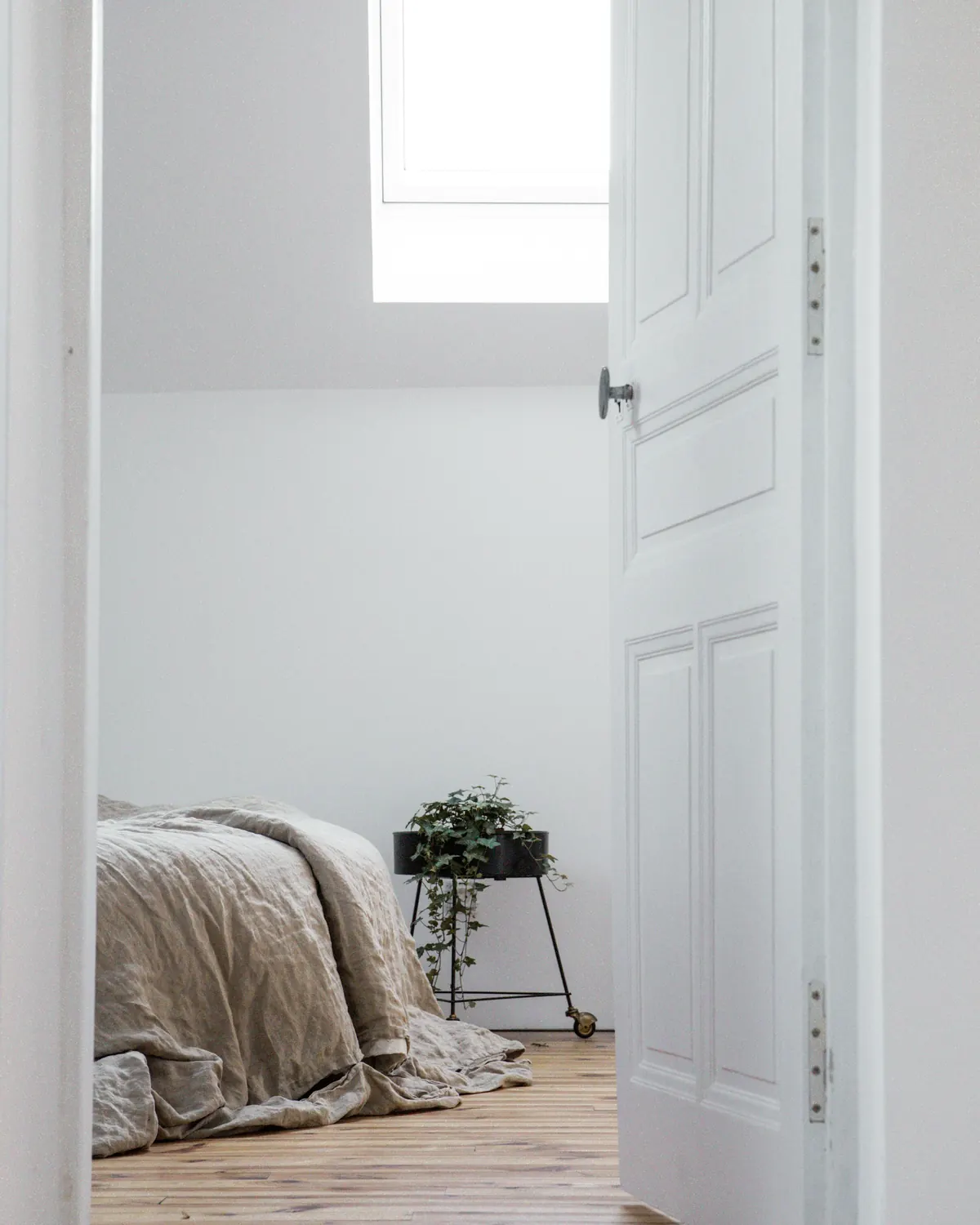
Imagine looking through an open doorway toward a bed dressed in relaxed beige linen. There's a plant nearby, a wooden floor and daylight coming in from above. The bed is inviting without looking untouchable.
That's the distinction worth remembering: hotel-inspired doesn't have to mean anonymous. You can keep the colors you like, the blanket with a family history and the bedding that has become familiar through everyday use. The goal is to borrow a sense of order without losing personality.
If your pillowcases don't match perfectly, that's fine. If your quilt has a pattern, let it become part of the room. A beautiful bed is not a competition in symmetry. It's a place to rest.
Three minutes every morning
Once the bed is fully dressed, keeping it that way can become a short daily ritual. This isn't a promise to change the sheets in three minutes; it's a quick refresh of bedding that is already on the bed. If your bedding needs airing first, give it the time it needs before you start.
That's enough. You don't need to inspect every wrinkle or redo the corners again and again. The point is a small gesture of care before the rest of your day.
A well-made bed doesn't ask you to live more perfectly. It simply makes the ordinary moment of coming home feel a little more special.
21:36The room at the end of the day
The bedside lamp is on. The book is waiting where you left it, and the bed is no longer a tangle of blankets and pillows. The layers have their places. The fold is still visible, though not as crisp as it was in the morning, and the familiar blanket is ready to be pulled close.
Nothing about the room has become less personal. If anything, the small amount of attention you gave it has made it feel more like yours. That's the part we love at ORIGIN.: good design doesn't always begin with new furniture or a new color. Sometimes it begins with using the things you already own a little differently.
If you enjoy these small changes, find more ideas for a cozy winter home without buying anything new. A bedroom doesn't need to imitate a hotel to feel welcoming. It only needs to make you happy to return.
Sources & notes
- Original practical guide by ORIGIN. House Studio. No external research, statistics, product recommendations, prices or brand claims are used.
- The eight-step method is an editorial adaptation of common bed-making techniques. It is not presented as the official procedure of any hotel.
- The three-minute routine refers to straightening a bed that is already dressed, not changing the sheets. Actual time depends on your bedding and routine.
- No particular thread count, fabric or number of cushions is required. The two photographs show different bedrooms; they are not a before and after.
- Photos (Unsplash License): Storiès, Liz Vo.
08:12Una mañana tranquila de sábado
Las cortinas están entreabiertas, una franja de sol atraviesa la cama y el libro de ayer sigue sobre la mesita de noche. Las sábanas están algo enredadas, una almohada desapareció debajo del edredón y la manta terminó amontonada a los pies del colchón.
Miras la cama e imaginas una de esas habitaciones en las que todo parece caer en su lugar de forma natural. Después miras tus propias sábanas. Seguro que hay una manera de lograr algo parecido sin reemplazar toda la ropa de cama.
La hay. Y empieza con algo mucho más sencillo que comprar textiles nuevos: prestar atención a cómo se relacionan las capas.
Una cama de hotel no depende de sábanas nuevas
Cuando pensamos en una cama de hotel, solemos imaginar ropa de cama blanca, almohadas generosas y mantas dobladas con una precisión extraordinaria. Pero esos son recursos visuales, no requisitos.
Una cama puede sentirse igual de acogedora con lino beige, sábanas de algodón de siempre, una colcha antigua o esa manta que te acompaña desde hace años. Lo importante es cómo cae la tela, cómo se resuelven las esquinas y si las almohadas crean un lugar cómodo para descansar. Quizá el dormitorio más personal sea el que toma un poco de ese orden sin perder nada de su carácter.
Empieza por lo que ya tienes. Un protector de colchón, una sábana bajera, una sábana encimera, una manta o un edredón y las almohadas que usas a diario son suficientes. No necesitas una colección de cojines decorativos. Necesitas una composición cuidada.
La belleza de las capas
Piensa en la cama como una composición que se arma desde el colchón hacia arriba. El protector va junto al colchón. La sábana bajera crea la superficie para dormir y la encimera suma una capa aparte debajo de la manta o el edredón. La manta aporta volumen y textura, y las almohadas completan el conjunto en la cabecera.
Cada capa tiene una función. Cuando la tela se distribuye de forma pareja y las esquinas se acomodan con cuidado, la cama se ve más ordenada sin resultar rígida. La idea no es que parezca que nadie ha dormido allí. Es crear un lugar al que te guste volver por la noche.
La cama de hotel en ocho pasos
- 1Despeja la cama
Retira las almohadas, la manta y las piezas sueltas para empezar desde el colchón. Si vas a cambiar las sábanas, comprueba que todo esté limpio y seco. No hace falta sumar capas solo por apariencia.
- 2Empieza por el protector
Si usas protector de colchón, colócalo bien estirado y ajústalo según su diseño. Alisa los pliegues que puedan molestar a la sábana bajera. Es la base de la cama, no una capa decorativa.
- 3Ajusta la sábana bajera
Extiende la sábana sobre el colchón y asegura bien cada esquina. Recorre los lados de la cama alisando la tela con las manos y comprueba que las esquinas queden en su lugar sin estirar el tejido de más.
- 4Centra la sábana encimera
Extiéndela de forma pareja sobre la bajera, con el lado más bonito hacia abajo si quieres que se vea al doblarla. Deja suficiente tela en la cabecera para doblarla después sobre el edredón y procura que ambos lados caigan igual.
- 5Coloca la manta o el edredón
Extiende la manta o el edredón sobre la sábana encimera, centrado respecto al colchón. Deja su borde superior un poco más abajo que el de la sábana, para poder doblarla encima. Alisa la superficie con suavidad, sin intentar eliminar cada pliegue natural.
- 6Haz el doblez superior
Dobla el borde de la sábana encimera hacia atrás, sobre la manta o el edredón, para formar una franja visible. Acomódala hasta que se vea continua y relajada. Para un aire más informal, también puedes doblar un poco el edredón.
- 7Cuida las esquinas
A los pies de la cama, mete la sábana encimera debajo del colchón si prefieres una terminación definida. Para una esquina más marcada, levanta la tela del costado, mete la parte inferior, baja la sección levantada y vuelve a meterla. Deja la manta o el edredón más sueltos si te resulta más cómodo.
- 8Acomoda las almohadas
Apoya las almohadas de dormir contra la cabecera, derechas o un poco inclinadas, y alisa sus fundas. Si ya tienes cojines decorativos, usa solo algunos delante. El conjunto debe ser fácil de deshacer a la hora de acostarte.
El doblez que cambia todo
Uno de los detalles más visibles es también uno de los más sencillos. Cuando la sábana encimera se dobla sobre el edredón, las capas aparecen. En lugar de un único bloque de tela, la cama gana estructura y variedad. No tiene que ser un doblez impecable: una línea suave en la parte superior basta para que el conjunto se vea cuidado.
Lo mismo pasa con las esquinas. Una sábana bien metida bajo el colchón da una terminación definida a los pies, mientras que un edredón suelto mantiene relajada la parte de arriba. Puedes combinar las dos cosas. No necesitas elegir entre una cama formal y una cómoda.
Errores comunes al tender la cama
- 01Estirar demasiado las capas Una cama bien tendida no tiene por qué sentirse apretada. Deja suficiente holgura para que la ropa de cama sea cómoda al acostarte.
- 02Olvidar centrar las sábanas Si sobra tela de un lado y falta del otro, toda la cama se ve torcida. Distribuye bien el tejido antes de hacer cualquier doblez.
- 03Usar demasiados cojines Una montaña de cojines puede verse bonita en una foto, pero se vuelve incómoda cada noche. Quédate con los que realmente disfrutas.
- 04Esconder por completo las capas Si buscas un aspecto en capas, deja ver un poco de la sábana encimera sobre la manta o el edredón. Con un solo doblez es suficiente.
- 05Confundir cuidado con perfección Las arrugas naturales y los textiles de siempre son parte de una casa habitada. La cama debe ser fácil de mantener, no otra tarea exigente.
Un dormitorio que sigue siendo tuyo
Imagina que miras desde una puerta abierta hacia una cama vestida con lino beige de caída natural. Hay una planta cerca, un piso de madera y luz natural que entra desde arriba. La cama invita a descansar sin parecer intocable.
Esa es la diferencia que vale la pena recordar: inspirarse en un hotel no significa crear una habitación impersonal. Puedes conservar los colores que te gustan, la manta con historia familiar y las sábanas que ya forman parte de tu rutina. El objetivo es tomar prestada una sensación de orden sin perder personalidad.
Si tus fundas no combinan a la perfección, no importa. Si tu colcha tiene un estampado, deja que forme parte del ambiente. Una cama bonita no es una competencia de simetría. Es un lugar para descansar.
Tres minutos cada mañana
Una vez que la cama está completamente vestida, mantenerla así puede convertirse en un ritual breve. No es una promesa de cambiar las sábanas en tres minutos; es un repaso rápido de la ropa de cama que ya está puesta. Si necesita ventilarse, dale el tiempo necesario antes de empezar.
Con eso basta. No necesitas revisar cada arruga ni rehacer las esquinas una y otra vez. La idea es dedicarle un pequeño gesto de cuidado a la habitación antes de seguir con el día.
Una cama bien tendida no te pide vivir de forma más perfecta. Solo hace que volver a casa se sienta un poco más especial.
21:36La habitación al final del día
La lámpara de la mesita de noche está encendida. El libro te espera donde lo dejaste y la cama ya no es un enredo de mantas y almohadas. Cada capa tiene su lugar. El doblez todavía se distingue, aunque no tan definido como por la mañana, y la manta de siempre está lista para acompañarte.
Nada de esto le quitó personalidad al dormitorio. Al contrario, esa pequeña atención hizo que se sienta todavía más tuyo. Eso es lo que nos gusta en ORIGIN.: el buen diseño no siempre empieza cambiando los muebles o eligiendo un color nuevo. A veces empieza usando de otra manera las cosas que ya tienes.
Si disfrutas estos pequeños cambios, descubre más ideas para una casa acogedora en invierno sin comprar nada nuevo. Un dormitorio no necesita imitar a un hotel para ser acogedor. Solo necesita darte ganas de volver.
Fuentes y notas
- Guía práctica original de ORIGIN. House Studio. No se usan investigaciones externas, estadísticas, recomendaciones de productos, precios ni afirmaciones sobre marcas.
- El método de ocho pasos es una adaptación editorial de técnicas habituales para tender la cama. No se presenta como el procedimiento oficial de ningún hotel.
- La rutina de tres minutos consiste en acomodar una cama que ya tiene sus sábanas y mantas, no en cambiar la ropa de cama. El tiempo real depende de cada persona y de los textiles.
- No se exige una cantidad de hilos, un tejido ni un número de cojines. Las dos fotografías muestran dormitorios distintos; no son un antes y un después.
- Fotos (licencia de Unsplash): Storiès, Liz Vo.