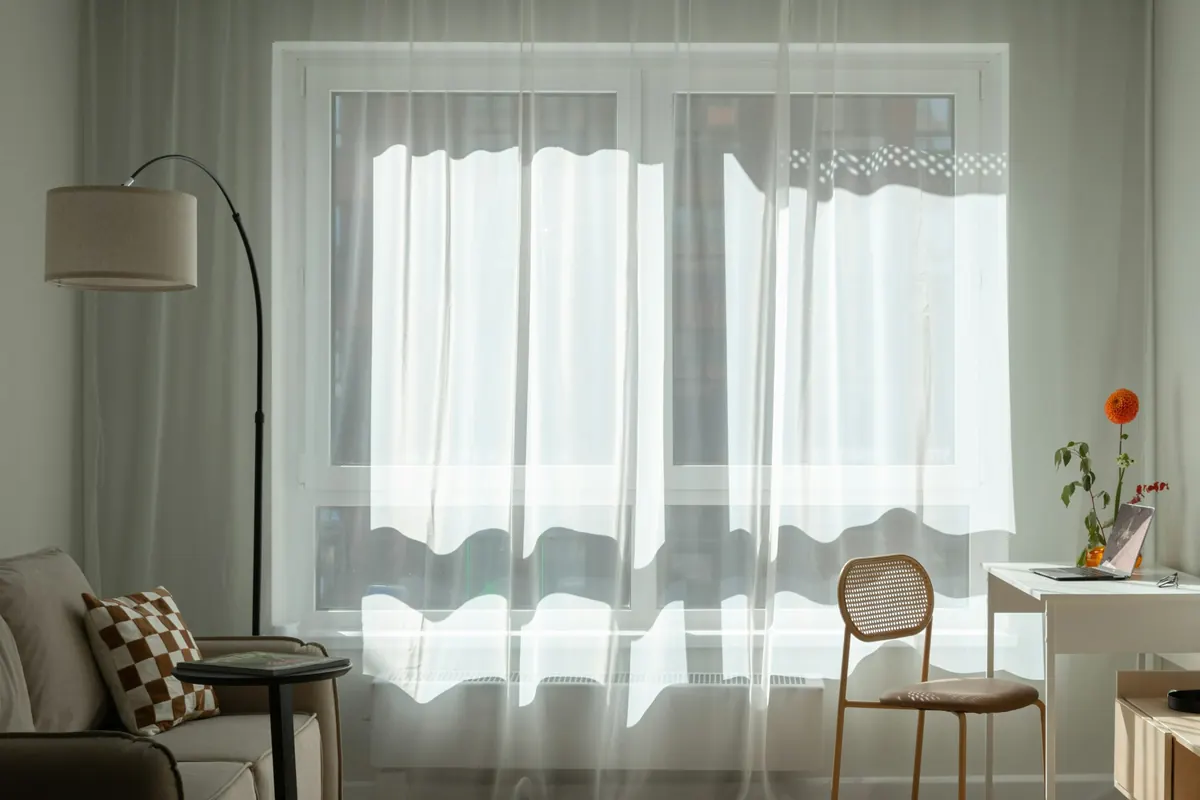
09:42A Sunday morning by the window
The curtains are open, sunlight is crossing the wooden floor, and the living room looks perfectly familiar. There's a sofa beneath the window, a lamp beside the chair and a desk that has slowly collected more books than it was designed to hold.
Nothing needs replacing. But you've been looking at the curtains. They seem to begin exactly where the window begins, and the whole arrangement feels a little compressed.
You wonder whether the rod should be higher. How much higher? Right beneath the ceiling? A few inches above the frame? And what happens if the windows don't all have the same shape?
These are small questions with surprisingly visible consequences. Fortunately, you don't have to redesign the room to answer them. You just have to understand the relationship between the window, the ceiling and the fabric.
Myth 1The rod belongs right on the frame
The curtain rod should always sit immediately above the window frame.
Designers often recommend lifting the rod above the frame when ceiling height allows. A higher position draws the eye upward and can change the apparent proportions of the window and the room.
Think of the rod as the beginning of a vertical composition. When it sits close to the top of the window, the fabric simply follows the window's outline. Move it a little higher and the curtains can draw a longer vertical line. Neither option changes the actual size of the room, but the way we perceive it can change.
It's a useful guideline, not a command. Before choosing a position, look at how much wall you have above the window and where the fabric will end. The arrangement needs to work as a whole.
Myth 2Anywhere above the window is fine
Once the rod is above the window, its exact position doesn't matter.
The Homes & Gardens guide gives 2 inches (about 5 cm) above the frame as a minimum, and describes 4–6 inches (about 10–15 cm) as generally preferable.
This is where a measuring tape is far more useful than guessing. Stand back and look at the space between the window and the ceiling. A rod just above the frame creates a different effect from one placed noticeably higher.
But the question isn't which measurement looks more impressive. It's whether the curtain height still feels connected to the window. If you're thinking of moving an existing rod, hold the tape against the wall and imagine where the fabric would begin. You may discover that a modest adjustment is enough.
Myth 3Low ceilings mean low curtains
In a room with a low ceiling, the rod should stay close to the window.
Hanging curtains higher can visually emphasize the room's height. When the space between frame and ceiling is limited, placing the rod between the two often gives a more balanced result.
In a compact room, every line becomes part of the overall impression: the top of the window, the edge of the curtain, the point where wall meets ceiling. Noelle Isbell of Noelle Interiors mounts drapery well above the window or door header, sometimes almost to the ceiling, when the aim is to make a room feel taller.
That doesn't mean the rod has to touch the ceiling. It means the wall above the window is worth considering rather than ignoring.
A halfway position gives you a practical place to begin. Then consider the curtain length, the surrounding architecture and the effect you want.
Myth 4With high ceilings, higher is always better
In a room with very high ceilings, curtains should always go as close to the ceiling as possible.
Designers sometimes take rods up to just below the crown molding, but very tall ceilings can call for a lower position that keeps the curtain related to the window.
This is one of those moments when a design idea needs a little restraint. A tall room may have architectural features worth emphasizing, and lifting curtains toward the molding can complement them. Kiley Jackson of Jackson Warren Interiors describes hanging curtains up to just below the crown.
But imagine a relatively modest window beneath an exceptionally high ceiling. If the rod is placed far above the frame, the fabric can start to feel disconnected from the window. Her design partner Aileen Warren notes that, with soaring ceilings, taking drapery all the way to the crown wouldn't make sense; there, about 4–6 inches (10–15 cm) above the window trim works better.
The lesson is simple. Height should serve the architecture, not compete with it.
Myth 5Arched windows need entirely new rules
An arched window makes the usual curtain-height guidelines useless.
Lucy Searle, global editor in chief of Homes & Gardens, recommends measuring from the highest point of the arch and keeping curtain heights consistent across the room.
An arched window already has a distinctive shape, and it deserves careful thought. But the solution doesn't have to be complicated. Instead of measuring from the lower sides of the arch, start at its highest point.
Then look around the room. Are there rectangular windows nearby? Do they share the same wall? A consistent top line helps different windows feel connected even when their shapes vary. The point isn't to hide the arch. It's to let the window shapes and the curtain lines live together comfortably.
Myth 6Once the rod is right, you're done
Choosing the right rod height is enough to make curtains look right.
Curtain length, fullness and how the fabric behaves when open also shape the result. Decide the rod height together with the curtain you actually plan to hang.
This is probably the most practical myth of all. You could choose a beautiful position for the rod and still end up with curtains that don't work for everyday life.
Consider how the fabric meets the floor. Some curtains just skim it, others stop slightly above it, and a longer treatment may pool on the floor. These are design choices rather than one correct answer, although pooled fabric can be less practical where people walk often or where curtains need regular washing.
Now think about width. If the curtains are meant to open, the rod should let the fabric move aside without needlessly covering the glass. No single number works for every window and every fabric, so look at how the curtains stack when open, whether they block handles and whether the window still opens normally. A beautiful arrangement should also be easy to live with.
You may find that your existing curtains can stay exactly where they are. Perhaps only the rod needs rethinking. Or perhaps the current arrangement already suits the window beautifully. Both discoveries are useful.
11:58The window, a little later
The sunlight has moved across the floor. The curtains are still open, and the familiar sofa sits beneath the window. You haven't replaced the fabric, bought a new lamp or painted the wall.
But now you understand the relationship between the rod, the window and the ceiling. You can see where the curtain line begins, how it affects the room and why the same measurement won't work equally well everywhere.
Sometimes the most beautiful change isn't adding something new. It's noticing where something already belongs.
That is the kind of decision we love at ORIGIN.: one that begins with observing, not shopping. And if the room still feels slightly off balance after you've rethought the curtains, find out what size rug your living room really needs. A room isn't a collection of isolated decisions. It's a conversation between the things already there.
Sources & notes
- Single source for measurements and guidance: Sarah Warwick, "How high should I hang my curtains? The rules designers follow", Homes & Gardens (January 23, 2023).
- Kelly Simpson (Budget Blinds) suggests about 4–6 inches (10–15 cm) above the window where ceiling height allows. The article gives 2 inches (5 cm) as a minimum and suggests a midpoint when there are 6–12 inches (15–30 cm) between frame and ceiling. Noelle Isbell (Noelle Interiors), Kiley Jackson and Aileen Warren (Jackson Warren Interiors) and Lucy Searle (Homes & Gardens) are quoted on tall rooms, very high ceilings and arched windows.
- No figures are given here for curtain width, rod overhang or floor clearance, because the cited article does not establish them. Those choices are discussed qualitatively.
- The opening scene, myth explanations and checklist are original editorial writing. The source offers professional guidelines, not binding installation standards.
- Photos (Unsplash License): Aleksandra Dementeva.
09:42Una mañana de domingo junto a la ventana
Las cortinas están abiertas, el sol atraviesa el piso de madera y la sala se ve completamente familiar. Hay un sofá debajo de la ventana, una lámpara junto a la silla y un escritorio que poco a poco ha reunido más libros de los que debería.
Nada necesita ser reemplazado. Pero llevas un rato mirando las cortinas. Parecen empezar exactamente donde empieza la ventana, y todo el conjunto se siente un poco comprimido.
Te preguntas si la barra debería estar más arriba. ¿Cuánto más? ¿Justo debajo del techo? ¿Unos centímetros sobre el marco? ¿Y qué pasa cuando no todas las ventanas tienen la misma forma?
Son preguntas pequeñas con consecuencias muy visibles. Por suerte, no necesitas rediseñar la sala para responderlas. Solo tienes que entender la relación entre la ventana, el techo y la tela.
Mito 1La barra va pegada al marco
La barra de las cortinas siempre debe quedar justo encima del marco de la ventana.
Los diseñadores suelen recomendar subirla por encima del marco cuando la altura del techo lo permite. Una posición más alta lleva la mirada hacia arriba y puede cambiar las proporciones aparentes de la ventana y de la habitación.
Piensa en la barra como el comienzo de una composición vertical. Cuando queda muy cerca del marco, la tela simplemente sigue el contorno de la ventana. Si la subes un poco, las cortinas pueden dibujar una línea vertical más larga. Ninguna de las dos opciones cambia el tamaño real de la habitación, pero sí la manera en que la percibimos.
Es una pauta útil, no una obligación. Antes de elegir la posición, observa cuánta pared hay sobre la ventana y dónde terminará la tela. La composición tiene que funcionar como un todo.
Mito 2Cualquier altura sobre la ventana da igual
Una vez que la barra está por encima del marco, su posición exacta ya no importa.
La guía de Homes & Gardens indica un mínimo de unos 5 cm (2 pulgadas) sobre el marco y considera preferibles, en general, unos 10–15 cm (4–6 pulgadas).
Aquí una cinta métrica es mucho más útil que adivinar. Aléjate un poco y observa el espacio entre la ventana y el techo. Una barra apenas por encima del marco produce un efecto distinto del de otra colocada claramente más arriba.
Pero la pregunta no es qué medida parece más impresionante. Es cuál mantiene la cortina conectada con la ventana. Si piensas mover una barra que ya tienes, apoya la cinta en la pared e imagina dónde empezaría la tela. Quizá descubras que basta con un cambio pequeño.
Mito 3Techo bajo, cortinas bajas
En una habitación de techo bajo, la barra debe quedar cerca de la ventana.
Subir las cortinas puede acentuar visualmente la altura del espacio. Cuando hay poca distancia entre el marco y el techo, colocar la barra entre ambos suele dar un resultado más equilibrado.
En una habitación compacta, cada línea forma parte de la impresión general: el borde superior de la ventana, la caída de la cortina, el encuentro entre la pared y el techo. Noelle Isbell, de Noelle Interiors, instala las cortinas bastante por encima del marco de la ventana o de la puerta, a veces casi hasta el techo, cuando busca que la habitación parezca más alta.
Eso no significa que la barra tenga que tocar el techo. Significa que vale la pena tener en cuenta esa franja de pared que solemos ignorar.
Esa posición intermedia es un buen punto de partida. Después considera el largo de la tela, la arquitectura y el efecto que buscas.
Mito 4Cuanto más alto el techo, más arriba la barra
En una habitación con techos muy altos, la barra siempre debe ir lo más cerca posible del techo.
A veces se sube hasta justo debajo de la moldura, pero los techos muy altos pueden pedir una posición más baja para que la cortina conserve su relación con la ventana.
Este es uno de esos casos en los que una buena idea necesita moderación. Una habitación alta puede tener detalles arquitectónicos que merece la pena destacar, y acercar las cortinas a la moldura puede acompañarlos. Kiley Jackson, de Jackson Warren Interiors, cuenta que a veces las cuelga hasta justo debajo de la moldura.
Pero imagina una ventana más bien pequeña debajo de un techo altísimo. Si la barra queda muy lejos del marco, la tela puede parecer desconectada de la ventana. Su socia Aileen Warren señala que, con techos muy altos, llevar las cortinas hasta la moldura no tendría sentido; ahí funcionan mejor unos 10–15 cm (4–6 pulgadas) sobre el marco.
La enseñanza es sencilla. La altura debe acompañar la arquitectura, no competir con ella.
Mito 5Las ventanas en arco tienen otras reglas
Si una ventana tiene forma de arco, las pautas habituales dejan de servir.
Lucy Searle, directora editorial global de Homes & Gardens, recomienda medir desde el punto más alto del arco y mantener la misma altura de cortinas en toda la habitación.
Una ventana en arco ya tiene una forma especial y merece atención. Pero la solución no tiene por qué complicarse. En lugar de medir desde los lados más bajos del arco, empieza por su punto más alto.
Después mira el resto de la habitación. ¿Hay ventanas rectangulares cerca? ¿Comparten la misma pared? Una línea superior coherente ayuda a que ventanas distintas se vean conectadas. No se trata de esconder el arco, sino de que las formas de las ventanas y las líneas de las cortinas convivan con naturalidad.
Mito 6Con la barra bien puesta, ya está todo resuelto
Elegir bien la altura de la barra basta para que las cortinas se vean bien.
El largo, la cantidad de tela y la forma en que se recoge al abrirse también influyen en el resultado. Decide la altura de la barra junto con la cortina que vas a colgar.
Este probablemente sea el mito más práctico. Puedes elegir una altura bonita para la barra y terminar con unas cortinas que no funcionan en el día a día.
Piensa en cómo llega la tela al piso. Algunas cortinas apenas lo rozan, otras terminan un poco por encima y las más largas pueden quedar apoyadas formando pliegues. Son decisiones de diseño, no una única respuesta correcta, aunque la tela que se acumula en el piso resulta menos práctica en zonas de paso o si hay que lavarla a menudo.
Ahora piensa en el ancho. Si las cortinas se abren, la barra debería permitir correr la tela hacia los lados sin tapar el vidrio sin necesidad. No hay una medida que sirva para todas las ventanas y todas las telas, así que observa cuánto espacio ocupa la cortina abierta, si interfiere con las manijas y si la ventana se sigue abriendo con normalidad. Una composición bonita también tiene que ser cómoda.
Quizá descubras que puedes dejar las cortinas exactamente donde están. Tal vez solo haya que replantear la barra. O puede que la distribución actual ya le quede perfecta a tu ventana. Cualquiera de esos descubrimientos es útil.
11:58La ventana, un poco más tarde
El sol se ha movido sobre el piso. Las cortinas siguen abiertas y el sofá sigue en su lugar. No cambiaste la tela, ni compraste una lámpara, ni pintaste la pared.
Pero ahora entiendes mejor la relación entre la barra, la ventana y el techo. Ves dónde empieza la línea vertical de la cortina, cómo influye en la habitación y por qué una misma medida no funciona igual en todos los espacios.
A veces, el cambio más bonito no consiste en sumar algo nuevo. Consiste en descubrir dónde debería estar lo que ya tienes.
Ese es el tipo de decisión que nos gusta en ORIGIN.: la que empieza observando, no comprando. Y si la sala todavía se siente algo desequilibrada después de revisar las cortinas, descubre de qué tamaño necesitas la alfombra de la sala. Una habitación no es una colección de decisiones aisladas. Es una conversación entre las cosas que ya forman parte de ella.
Fuentes y notas
- Única fuente para medidas y pautas: Sarah Warwick, "How high should I hang my curtains? The rules designers follow", Homes & Gardens (23 de enero de 2023).
- Kelly Simpson (Budget Blinds) propone unos 10–15 cm (4–6 pulgadas) sobre la ventana cuando la altura lo permite. El artículo indica un mínimo de 5 cm (2 pulgadas) y una posición intermedia cuando hay 15–30 cm (6–12 pulgadas) entre el marco y el techo. Noelle Isbell (Noelle Interiors), Kiley Jackson y Aileen Warren (Jackson Warren Interiors) y Lucy Searle (Homes & Gardens) opinan sobre habitaciones bajas, techos muy altos y ventanas en arco.
- No se dan medidas de ancho, de cuánto sobresale la barra ni de la distancia al piso, porque la fuente no las establece. Esas decisiones se explican de forma cualitativa.
- La escena inicial, las explicaciones de los mitos y la lista son contenido editorial original. La fuente ofrece pautas profesionales, no normas obligatorias de instalación.
- Fotos (licencia de Unsplash): Aleksandra Dementeva.